Why Leadership Development Matters in Today’s Changing World
The Thunder Beyond the Silence: How Community Archives Transformed My Understanding of Memory
For much of my professional life, I walked the quiet, climate-controlled corridors of institutional archives. As a librarian and archivist, I learned to value provenance, authenticity, preservation, and the careful stewardship of records that document institutions, governments, and organizations. Those repositories remain indispensable. They preserve evidence, ensure accountability, and safeguard society’s documentary heritage.
Yet, the longer I worked within institutional archives, the more another kind of silence demanded my attention. It was not the silence of the reading room.
It was the silence of communities.
As I processed records and navigated collections, I increasingly noticed that many communities—particularly those historically marginalized—appeared only in fragments, through administrative reports, official correspondence, or the perspectives of others. Their histories were documented, but their voices were often absent. Their experiences were preserved, but rarely on their own terms.
That realization prompted a question that has continued to shape my work:
Whose memory becomes history, and who decides?
The search for an answer led me beyond institutional repositories and into the remarkable world of Community Archives.
There, I encountered something profoundly different.
If institutional archives preserve the documentary evidence of society, community archives preserve its heartbeat.
Here, the voices of our ancestors and community members do not whisper—they thunder.
Every photograph is more than an image; it is an inheritance. Every oral history carries not only facts but emotion, identity, and belonging. Every handwritten letter, family record, community newsletter, cultural artifact, and personal testimony reminds us that archives are not simply repositories of information—they are repositories of lived experience.
Community archives taught me that preserving memory is not merely a technical exercise; it is a profoundly human one.
They challenge one of the longest-standing assumptions in archival practice: that institutions alone determine what is worthy of preservation. Instead, they redistribute archival authority, allowing communities to decide what should be remembered, how it should be described, and how future generations will encounter their heritage.
This is not simply about collecting records.
It is about restoring agency.
It is about archival justice.
It is about ensuring that communities are not merely subjects of history but authors of their own memory.
This journey has fundamentally reshaped how I understand my role as an archivist.
I no longer see archivists solely as custodians of records. We are listeners, collaborators, facilitators, and partners in memory-making. Our responsibility extends beyond preserving documents; it includes building trust, supporting community stewardship, and creating archival spaces where diverse voices can exist with dignity, authenticity, and respect.
My experience has also taught me that institutional archives and community archives should never be viewed as opposing models.
They are complementary.
Institutional archives preserve evidence.
Community archives preserve experience.
Institutional archives often answer what happened.
Community archives help us understand what it meant to the people who lived it.
Neither is complete without the other.
Together, they offer a fuller, richer, and more truthful understanding of our collective past.
As our profession continues to grapple with questions of inclusion, representation, Indigenous data sovereignty, participatory description, digital preservation, and ethical stewardship, I believe the future of archival practice lies not in choosing between institutional and community archives, but in building meaningful partnerships between them.
Because memory is strongest when authority is shared.
Looking back, I realize that my journey was never simply about moving from one type of archive to another.
It was about moving from preserving records to understanding relationships.
From documenting events to honouring lived experiences.
From hearing silence to listening to thunder.
Today, I carry one conviction with me:
In community archives lie the voices of our ancestors and the experiences of the living.
If we fail to preserve those voices, we lose far more than historical records.
We lose identity.
We lose belonging.
We lose culture.
We lose the wisdom that communities carry across generations.
And perhaps the greatest responsibility of archivists today is not simply to preserve the past, but to ensure that every community has the opportunity to tell its own story—in its own voice, on its own terms, and for generations yet to come.
#CommunityArchives #ArchivalStudies #Archives #CollectiveMemory #ArchivalJustice #MemoryWork #ParticipatoryArchives #LibraryScience #InformationScience #DigitalHumanities #CulturalHeritage #DecolonizingArchives #PublicHistory #Archivist
About the Author
Okereke Anyim, Ph.D. is an archival scholar, librarian, and information professional with over 15 years of experience in archives, academic libraries, and information management. A two-time substantive University Librarian, he has authored more than 45 peer-reviewed publications and has led archival and cultural heritage initiatives, including the establishment of the Niger Delta Archives at Edwin Clark University, Nigeria. He has also received advanced archival and information training at the University of British Columbia, Canada, further strengthening his expertise in archival studies, digital preservation, and emerging technologies in cultural heritage.
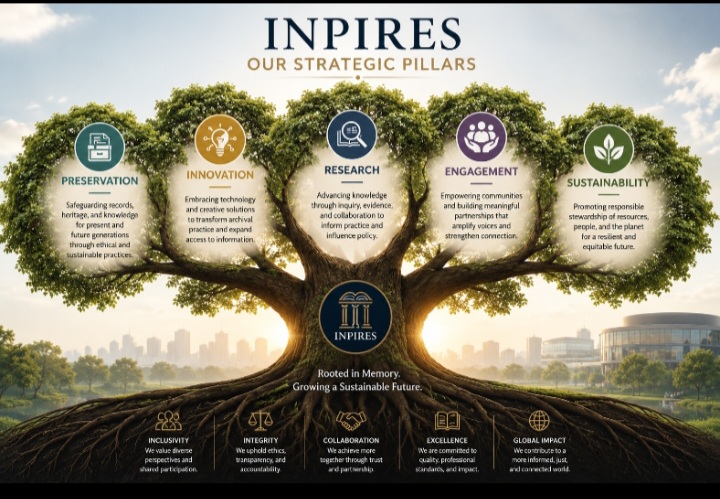
His research and professional practice focus on archival innovation, community archives, digital preservation, cultural memory, artificial intelligence, metadata, and the ethical use of technology in archival systems. Through INPIRES, he writes on the future of archives, community memory, and digital heritage, promoting inclusive, research-informed, and community-centred approaches to preserving documentary heritage for present and future generations.
Okereke Wisdom Anyim, PhD
Lorem ipsum dolor sit amet, consectetur adipiscing elit. Ut elit tellus, luctus nec ullamcorper mattis, pulvinar dapibus leo.

Leave a Reply